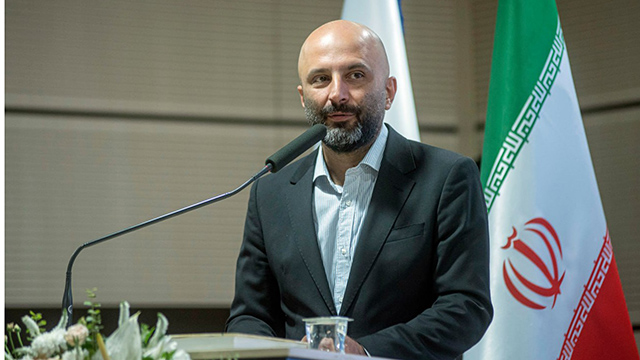
Mr. Ehsan Kiani Deputy CEO of Bisotoun Steel, announced the implementation of an energy recovery thermal power plant project at this industrial complex.
1. Introduction
Bisotun Iron Smelting Company is one of the largest manufacturing industries in the western region of the country, whose product is sponge iron production and ultimately steel ingot production at the rate of 200 thousand tons per year. In the process of work and heat treatment and metallurgy, sponge iron is produced in three stages, first, then melting, and finally steel ingots are produced. The steel ingots are converted into raw materials and required for the production of iron beams and rebars in various dimensions in other companies affiliated with the complex that have been built and constructed on site after the iron smelting and ingot production units. In the studies conducted on the thermal energy of the exhaust gas (smoke from the chimney) that has so far entered the environment and is wasted, it is possible to convert the thermal energy of the exhaust gas into electrical energy at the rate of 12 megawatts by constructing a steam thermal power plant.

2. Project Report
Considering the current state of electricity production in the country and the imbalance between energy supply and demand, coupled with restrictions on electricity and other energy sources, the depletion of underground oil reserves, and the global economic value of fossil fuels, many countries, including Iran, have shifted toward building power plants that utilize renewable energy sources. Consequently, fossil fuel-based thermal power plants using natural gas, diesel, or fuel oil are being phased out.
In this regard, Bisotoun Steel, having conducted technical and economic assessments, decided to construct a 12-megawatt thermal power plant utilizing the considerable thermal energy of the exhaust gases from the factory’s chimneys—without the use of any fuel such as gas, diesel, or mazut.
The necessary planning has been completed, including the preparation of a CPM schedule. If the required financial resources are secured and operational prerequisites are met, the power plant is expected to be launched and go into operation next year. The physical progress of the project has currently reached 70%.
3. Electricity Generation Process
As previously mentioned, the heat energy from the exhaust gases of the Direct Reduction Unit at Bisotoun Steel is significant, with a temperature of 1,000°C and a flow rate of 1,300,000 NM³/Frac. This energy will be recovered through a Waste Heat Recovery Boiler (WHRB), which transfers the heat to boiler tubes through Waterwall, Economizer, Evaporator, and eventually the Primary and Final Superheater tubes.
The boiler water is converted into superheated steam at 485°C, 65 kg/cm² pressure, and 60,000 kg/hr steam flow. This steam will enter a turbine with 18 rows of fixed and moving blades, rotating at 6,000 RPM. The turbine shaft is connected to the generator rotor shaft via a gearbox and coupling, spinning the generator at 1,500 RPM. According to electromagnetic principles, this will generate 12 megawatts of electricity, which can be fed either into the national grid through a transformer or distributed locally through internaltransformers.
4. Advantages of the Power Plant at Bisotoun Steel
A. According to national regulations, the government is responsible for supplying fuel to power plants or subsidizing their cost. On average, a power plant operating 10 months a year would consume around 15 million liters of gas or diesel. By eliminating this fuel consumption, significant savings are achieved for the government.
B. Since the power plant generates electricity without using any fuel, the annual savings of 15 million liters not only conserves resources but also reduces environmental pollution and greenhouse gas emissions such as NOX.
C. Given the national energy imbalance and energy crisis, the generated electricity can compensate for local shortages
D. As the point of consumption is adjacent to the plant, there is no transmission loss, and the existing infrastructure is fully prepared to handle the local distribution of electricity.

 |
 |
 |