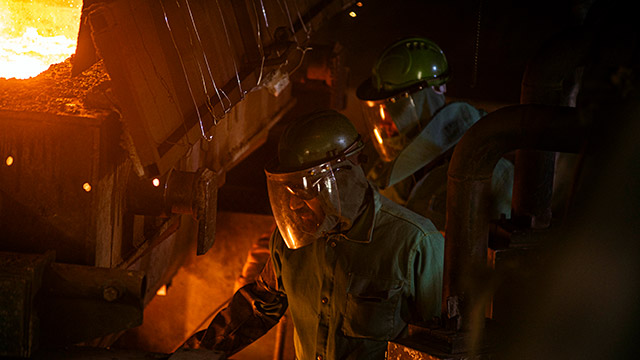
Due to the nature of its production processes, heavy equipment, steel melting furnaces, and the use of high-risk energy sources, the steel industry has always been considered a high-risk sector. Therefore, implementing an effective Health, Safety, and Environment (HSE) management system plays a vital role in protecting human capital and ensuring sustainable production at Bisotoun Steel.
Assessments conducted by Bisotoun Steel’s HSE Department indicate that the number of workplace accidents at the company has followed a consistent downward trend in recent years, accompanied by significant improvements in safety performance indicators. This reflects the effectiveness of the company’s preventive measures and its systematic approach to occupational safety management.
Before the Industrial Revolution, human physical labor was the primary source of energy for producing goods and providing services, while control over work-related hazards largely remained within individual work groups. With the advent of industrialization and the widespread adoption of various energy sources, production processes gradually became mechanized and automated. At the same time, the increasing flow of energy contributed to a greater likelihood of accidents with potentially severe consequences.
Despite significant advances in occupational safety and a substantial reduction in workplace accidents over recent decades, industrial incidents remain a major challenge in working environments. This is particularly important in steelmaking plants due to their unique operating conditions, diverse equipment, production of steel and alloy billets, use of direct reduced iron (DRI), and operation of induction and steel-melting furnaces.
Under such conditions, employees may be exposed to hazards including burns, slips, falls, physical injuries, and accidents involving heavy machinery and equipment. Although international guidelines, including recommendations from the International Labour Organization (ILO), provide appropriate frameworks for safety management, effective control of occupational accidents requires a systematic, data-driven approach supported by continuous training and safety awareness at every organizational level.
In line with this approach, Bisotoun Steel’s HSE Department has implemented a series of targeted measures to meet HSE management system requirements and establish a safer workplace. These measures include root-cause analysis of accidents and near misses, daily inspections, continuous workplace risk assessments, corrective and engineering controls, and specialized safety training programs.
Assessments conducted based on standard safety indicators and criteria recognized by reputable authorities, including the approaches of the Occupational Safety and Health Administration (OSHA), (OSHA)
indicate that Bistoon Steel’s safety performance is at a satisfactory and acceptable level, with continuous improvement in this area ongoing. This achievement is the result of the sustained efforts of the company’s employees and HSE specialists. HSE
and the management approach of the Shokri Industrial Group to strengthening safety culture, preventing workplace accidents, and protecting human capital. This approach is helping Bistoon Steel move toward creating a safer working environment, reducing occupational illnesses, and achieving its broader industrial and human development objectives.